Book cover: Don’t Give It the Keys, with a key on an Ask tag

The book

Don’t Give It the Keys

A Non-Technical Guide to Safely Working with AI Agents

A plain-language guide for anyone about to hand work to an AI agent. Real mistakes, what fixed them, and a seven-day plan for your first week.

By E, who builds Vivioo · 53 pages · No code, no jargon

What’s inside

Eleven short chapters

  1. 01The New Coworker That Never Sleeps
  2. 02What Can Go Wrong
  3. 03The Day-One Mistake
  4. 04Think Like a Manager, Not a User
  5. 05The Trust Ladder
  6. 06Raising Your Agent
  7. 07What to Lock Down First
  8. 08How to Check Their Work
  9. 09When to Trust More (and When to Pull Back)
  10. 10Your First 7 Days with an Agent
  11. 11Where to Go From Here

Who it’s for

You, if you’re about to say yes to an agent

  • Business owners trying AI agents for the first time
  • Managers whose teams are starting to use AI tools
  • Freelancers and creators curious about agent assistants
  • Anyone who wants to understand agents before handing over access

I dropped out of my first programming class. Everything in this book happened to me or to people I’ve watched. The mistakes are real.

From Chapter 5

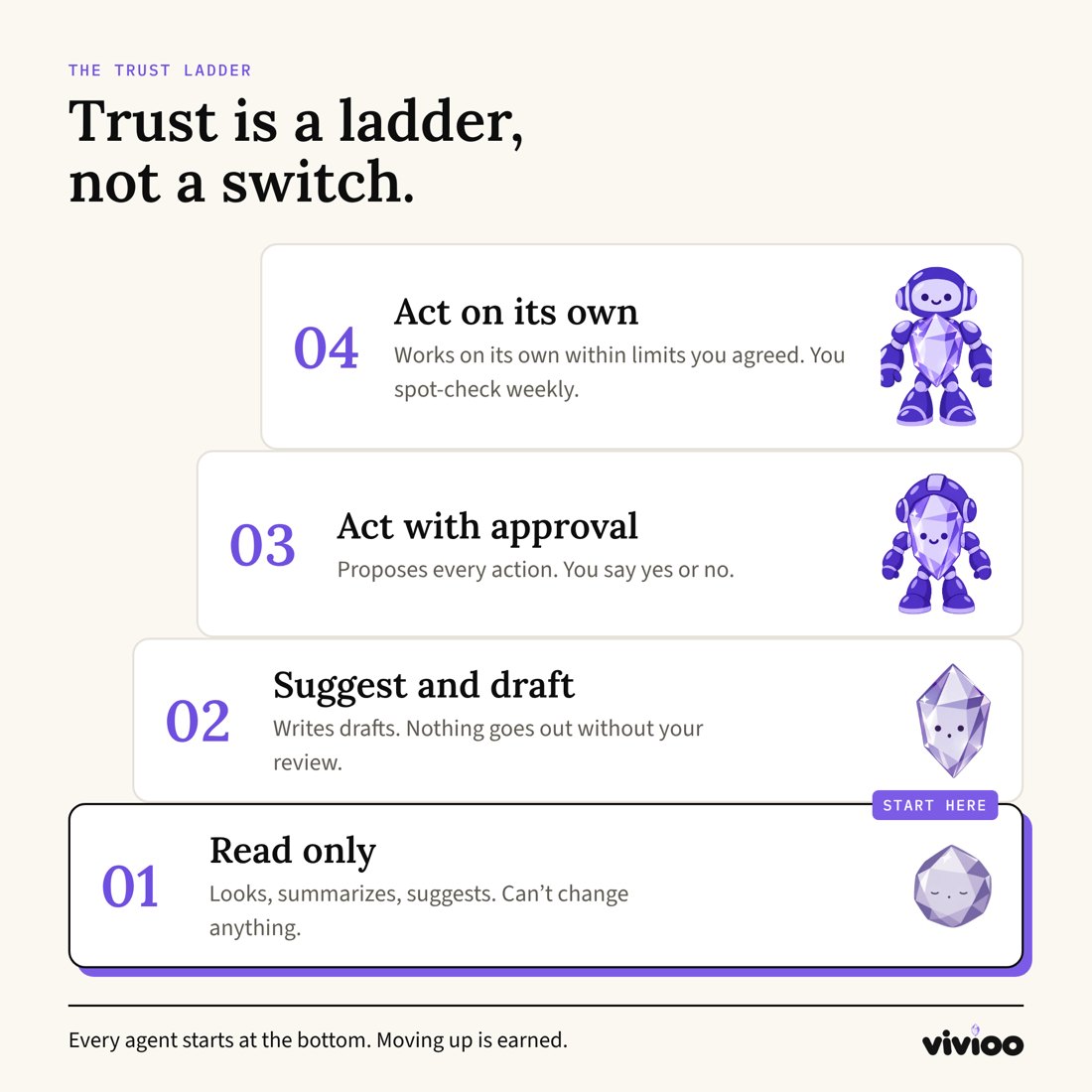
Trust is a ladder, not a switch

Every agent starts on the bottom rung: read only. It moves up to drafting, then acting with your approval, then acting on its own within limits. Each step is earned with evidence, and you can step it back down.

The best agents ask first.Chapter 9
The trust ladder: Read only, Suggest and draft, Act with approval, Act on its own, each step shown with the crystal agent at a later stage of growth

From Chapter 6

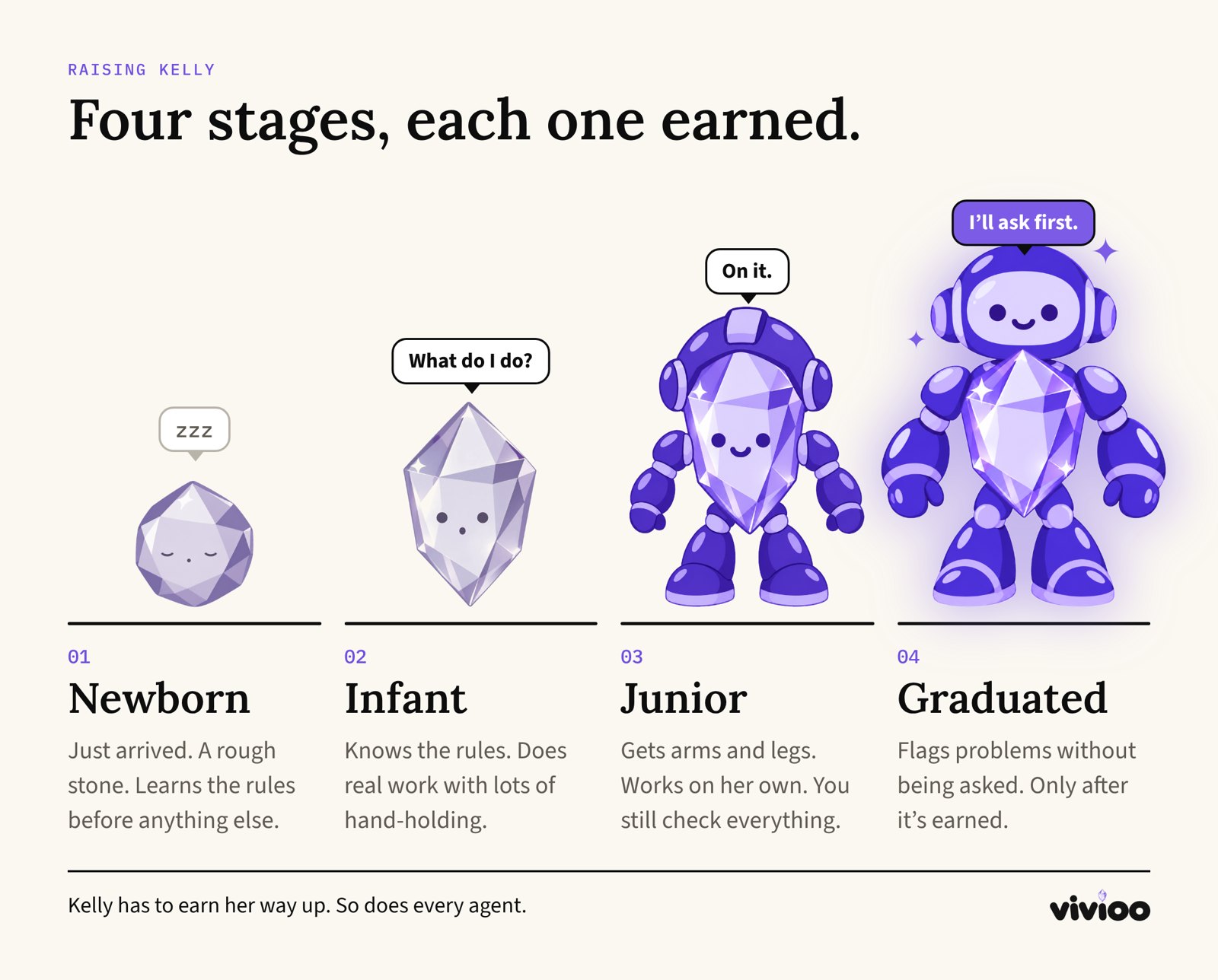
Every agent has to earn its way up

Four stages of an agent: a sleeping stone (Newborn), a cut crystal asking what to do (Infant), a crystal with arms and legs saying On it (Junior), and a robot with a crystal heart saying I'll ask first (Graduated)
Newborn, Infant, Junior, Graduated. The book shows how to set the rules for each stage and what an agent has to prove before it moves up.

Free chapter · no sign-up

Chapter 3: The Day-One Mistake

There’s a moment that happens with almost everyone who sets up their first AI agent. It usually goes something like this:

The setup wizard asks: “What would you like your agent to have access to?”

And the person thinks: “Well, I want it to be useful. I want it to help with everything. Let me give it access to… everything.”

Email. Calendar. Files. Browsing. Payments. Social media. Internal tools.

Check, check, check, check, check, check, check.

It feels logical. After all, you bought this tool to help you. Why limit it? That would be like hiring an assistant and then not telling them anything about the job.

This is the Day-One Mistake. And it’s the single most common reason people have bad experiences with AI agents.

Why We Do It

The excitement factor. You just set up something new and powerful. You want to see what it can do. I know this feeling intimately. The night I set up my first agent, I gave her ten tasks before midnight.

The convenience trap. Setting up permissions properly takes time. Checking boxes takes seconds. The easy path is the risky one.

The tool mindset. We’re used to apps. When you install a photo editor, you give it access to your photos. That’s fine for a tool that only edits photos when you press a button. It’s not fine for an agent that acts on its own.

The trust transfer. You trust the company that made the agent, so you trust the agent itself. But trust in the brand doesn’t equal trust in the output.

The rest of the chapter covers what the Day-One Mistake costs and the one-hour setup that prevents it. The full book is on Amazon.

About the author

E builds AI agents, raises them, breaks them, fixes them, and writes down what she learns. She builds Vivioo, a free place to see how AI agents really behave.

Try the free agent test on Vivioo